


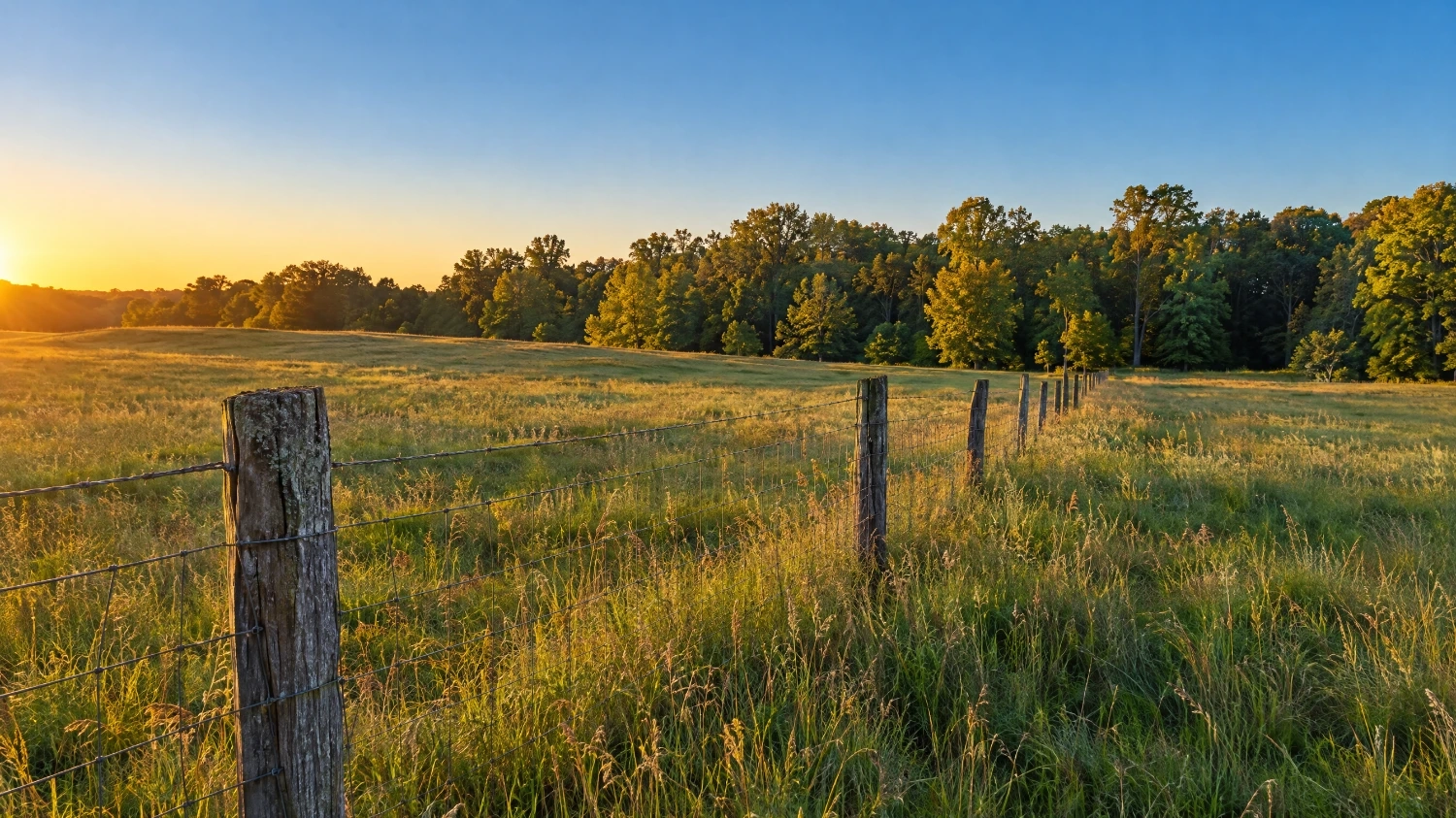
Land is the one purchase where falling for the view first and asking questions later goes wrong most expensively. A beautiful tract can turn out not to support the house you pictured, or to have no legal access, or to cost far more to make usable than it cost to buy. None of that is hidden. It is just that nobody asks until they are already attached. If you are looking at acreage or a small farm around Denver, Lincolnton, or anywhere else in Lincoln County, these are the questions to settle first.
First question: will it support a septic system
Most rural tracts here are not on public sewer, so the land has to handle its own wastewater. That means a soil evaluation. The county health department evaluates the soil and, if it passes, issues the permit that says what kind of system the site can support and how many bedrooms it is good for.
Two things surprise buyers. The first is that a lot can fail, or can pass only for a smaller or far more expensive system than a conventional one. The second is that the permit is tied to a specific plan: a site that supports a three-bedroom house does not necessarily support the five-bedroom one you have been drawing.
If the seller already holds a permit, read it rather than taking the summary on faith, and check whether it is still valid and whether it matches what you intend to build. If there is no permit, make the evaluation a condition of your purchase and give the process enough time. This is the single step most likely to change whether the land works for you.
Where the water comes from
If there is no public water line, you are drilling a well or using an existing one. For an existing well, ask for the construction record and the permit, and test the water before closing rather than after. For a new well, the county issues the permit, and your builder or a local driller can tell you what depths and yields are typical nearby.
Where a well and a septic system share a site, the separation distances between them, and from property lines and surface water, shape where each can go. On a small or awkwardly shaped tract that geometry occasionally decides where the house itself can sit.
What you are allowed to do with it
Zoning sets what uses are permitted, how far structures must sit from the lines, and whether the parcel can be divided later. County zoning applies outside the towns, and inside a town or its extraterritorial area the town's ordinance governs instead, which is easy to get wrong on a parcel near a boundary.
Recorded restrictions can be stricter than zoning and often are. A tract cut out of an old family farm may carry covenants limiting livestock, mobile homes, outbuildings, or further subdivision. If keeping chickens, horses, or a workshop is part of the plan, confirm it is permitted both by the ordinance and by whatever is recorded against the deed.
Also look for easements. Utility easements, drainage easements, and a neighbor's right of way across your land all affect where you can build and what you can plant. They sit in the title work, which is a good reason to have an attorney involved early on a land purchase rather than at the end.
Access, boundaries, and the survey
Confirm there is legal access, not merely a track that everyone has always used. A parcel reached by crossing someone else's land needs a recorded easement or frontage on a public road. Informal arrangements that have worked for thirty years are not a right, and a lender may well insist on the point even if you are relaxed about it.
Ask whether access is by a state-maintained road or a private one. Private roads come with maintenance obligations that may be shared with neighbors, formally or not at all, and both arrangements are worth understanding before the first winter.
Then there are the lines themselves. Rural land often comes with an old survey, a vague one, or none. Fences wander, hedgerows are not boundaries, and acreage in an old deed description is not always what a modern survey finds. A new survey is a modest cost against the alternative, which is discovering the problem once a barn is built.
Financing land is not the same as financing a house
Lenders treat raw land as a different risk from an occupied home. Expect a larger down payment, shorter terms, and fewer lenders interested, and expect local banks and farm credit lenders to be more comfortable with it than a national mortgage desk. If you intend to build, a construction loan that rolls into a permanent mortgage is often the cleaner path, and it has its own requirements about plans, permits, and builders.
Have that conversation before you make an offer. The financing route shapes the timeline, and on land the timeline is also driven by the soil evaluation, the survey, and the title work, none of which hurry along for anyone.
The trade-offs worth saying out loud
Acreage buys quiet, room, and the freedom to do your own thing. It also buys upkeep that does not pause, longer drives to everything, and services that may be thinner than you are used to. Check broadband availability at the specific address rather than the area, confirm whether trash is collected or hauled, and look at where the nearest fire station is, because that can affect insurance.
For some buyers that list is a fair price for the life they want. For others a smaller lot twenty minutes closer in is honestly the better fit. We would rather help you work out which of those you are before you buy twelve acres and find out.
If you are weighing the area as well as the land, our Denver, NC pages cover what is around, and the land listings are the place to see what is available.
This is general information, not legal advice; confirm specifics with your agent or a real estate attorney.
Gonzalez Realty is an Equal Housing Opportunity firm. We do not discriminate on the basis of race, color, religion, sex, handicap, familial status, or national origin.
This post is for general educational purposes only and is not legal, tax, or financial advice. Real estate laws, loan programs, and market conditions change over time, and older posts may not reflect current details. Confirm specifics with your agent, a real estate attorney, a lender, or a tax professional before making a decision.
Portions of this content were drafted with AI assistance and reviewed by our team before publishing. Nothing on this page creates a client relationship with Gonzalez Realty.